
Introduction
Greetings! In Episode 6 of this rather unique blog, we’re diving into Flying Fox Coffee and one of the region’s most interesting trees: the Water Oak.
☕ First Up: Coffee ☕
Flying Fox Coffee Scorecard
Overall Score: 84 / 100
(Average of all ten categories: 8.3)
Category…Score
Beans….8.8
Drip….7.9
Pour Overs…..N/A
Espresso Drinks…..9.6
Non Coffee…..6.5
Food……….8.5
Vibe…..8.4
Seating…..8.9
Work-Friendliness….9.0
Parking & Access….8.3
Overview

Flying Fox Coffee originally opened inside the Cartwright Food Hall in downtown Greer—that’s where I first found them. They showed up on Google Maps, so I headed that way. There was no signage from the street, so it took a hot minute to track them down. Once I figured it out, though, I discovered that Cartwright is actually a great spot to settle in and get some work done, and I was pleasantly surprised by the mocha I purchased.
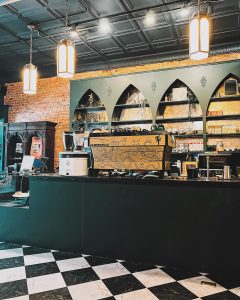
In August 2024, Flying Fox opened a full café just across the street in the location formerly occupied by Stomping Grounds. No missing it now—the entire building is painted in their signature deep green, inside and out. If you’re a Birds fan visiting from out of state, this might just be your spot. For Greenvillians, it feels like Greer’s own version of Coffee Underground—same dark, kind of Persian-y vibe.
Menu
Flying Fox roasts their own beans, and that’s a major plus for me. Shops that do that tend to be better across the board, and this is no exception. The drip offerings are tasty, and the bagged coffee is well worth picking up for home brewing. But where Flying Fox really shines is their espresso.
Their lattes rank among the best in the Greenville area, and it’s all thanks to their signature espresso roast. I’m not sure why it’s so obviously better than what most other shops are using—but it is. For comparison: if you’re used to Dunkin’ Donuts or Starbucks lattes, the actual coffee is often the worst part of the drink. It’s usually over-roasted, bitter, and leaves a weird aftertaste. That’s why SO MUCH SUGAR IS ADDED. They’re actively hiding the flavor.
Now listen—sugar and milk have their place, and obviously, those chains are doing just fine. But the difference in quality is staggering. You can actually taste the coffee in a Flying Fox latte, and that is far from a bad thing.
“Okay, sure,” you might say, “of course a local artisan coffee shop is going to have better espresso than Starbucks or Dunkin’. But how does it compare to other local shops?”
Great question! It’s up there with the very best.
A latte is a mix of espresso, milk, and often some kind of flavored syrup. But depending on the ingredients, ratios, and technique—even something as small as the temperature used to pull the shot—the flavor can vary wildly. It’s part art, part science. And there are multiple great (and I mean truly great) coffee shops in the Upstate. Flying Fox is one of them.
That said, once you get outside anything espresso-related, the quality dips a bit—at least in my opinion. Some of that might come down to personal taste. (Let’s be honest, all of this comes down to personal taste.) But if we’re talking strictly lattes and espresso drinks, Flying Fox is right there at the top. In other areas, I’d say they’re a step behind the best of the best.
They also serve food, and it’s a neat little selection. Not on the level of Tandem or Barista Alley, but definitely respectable. It’s exactly the kind of thing you’d want alongside a cappuccino.
Also worth mentioning: their rotating seasonal specials. They’re often clever—sometimes even a little satirical—and generally worth a try.
Location & Workability

- Atmosphere: Darker and more private than Barista Alley, making it a solid choice for getting work done. I’ve already called it “Greer’s Coffee Underground,” and that holds up.
- Seating & Wi-Fi: A good mix of communal tables and a few couches, with outlets and Wi-Fi available. The Wi-Fi does drop out occasionally, so that’s worth noting. There’s also a small, private-feeling room in the back, though it can feel a bit awkward if someone else is already in there.
- Parking & Access: Similar to Barista Alley but arguably better, as it’s near several lots and closer to the bottom of Main Street.

In Summary
- Espresso Lovers: Don’t miss their seasonal latte specials.
- Coffee-at-Home Crowd: Grab a bag of their single-origin roast—they roast in-house and switch things up often.
- Midday Pick-Me-Up: Try the Monte Cristo sandwich with a fruit cup and a latte. It’s a crowd favorite.

Comparison
Here’s how things stack up so far using our “official” ranking system:
- Barista Alley – 91
- Unlocked – 89
- Methodical – 89
- Tandem – 87
- Due South – 84
- Flying Fox – 84
We’re spoiled with coffee shops here in the Upstate. Flying Fox would easily be a top-tier shop in most cities, but around here—where quality roasters and brewers are everywhere—it almost flies under the radar. That said, hear me clearly: Flying Fox in Greer is right up there with the best when it comes to lattes and espresso-based drinks. The same goes for their artsy Downtown Greenville location.
🌳 The Water Oak: The angsty oak in constant need of a trim🌳

Water oaks are some of the most fascinating—and frustrating—trees in South Carolina. Known to botanists as Quercus nigra, this fast-growing oak can be found all across the Upstate. It’s a vital part of our local ecosystem, but oh, can it be a wild card. When it’s at its best, it’s strikingly beautiful—even majestic. But when it’s at its worst? It can look downright ugly, like a tangled, unruly mess. You know those viral reels where a barbershop takes an average-looking guy, gives him a fresh cut, and suddenly he looks like a model? That’s often how I see water oaks. Beneath all that tangled, leafy bush-like growth along the trunk is an oak—strong, striking, stately—but you miss it, buried under all that mess.
What Is a Water Oak?


The water oak is a medium-to-large deciduous (leaf-shedding) tree that typically grows 60 to 80 feet tall with a broad, rounded canopy (the leafy crown of the tree). Its leaves are spoon-shaped—narrow at the base and wider at the tip—with smooth or lightly lobed (gently indented) edges. They turn yellow-brown in fall and may cling to the branches well into winter [1].
Unlike slower-growing relatives like the white oak (Quercus alba), water oaks shoot up fast. That rapid growth made them a go-to shade tree throughout the 20th century, especially in Southern cities and neighborhoods [2].
Why Is It Called a Water Oak?
The name comes from its love of wet places. You’ll find water oaks thriving near creeks, swamps, floodplains, and drainage ditches. They handle soggy, poorly drained soil better than many other oaks, making them an essential part of riparian (streamside) ecosystems [1][3].
Bushy Growth and the Need for Pruning

One thing that sets the water oak apart is its tendency to develop dense, twiggy shoots along the trunk. Left unchecked, these lower limbs give the tree a “bush tree” look—like an overgrown shrub rather than a stately hardwood.
They need regular haircuts. But when pruned correctly, they clean up beautifully. They can be tricky to climb due to the lower clutter, but the results are worth it. We’ve gone from “ugly shrub” to “handsome tree” in a single morning many times.
And it’s not just about appearances. That dense lower growth saps energy from the canopy, reduces airflow, traps moisture, and invites fungal issues. Early and regular pruning helps guide healthy growth and build a stronger structure.
At Dill Tree Care, we recommend pruning inspections every 1–2 years to manage sprouts and ensure the tree’s energy is going where it counts. Thoughtful, selective pruning (targeting specific limbs) improves the tree’s shape, relieves stress on older limbs, and lowers the risk of future breakage.
Benefits and Drawbacks
Ecologically, water oaks support wildlife with their fast-growing acorns—an important food source for deer, squirrels, ducks, and wild turkeys [3]. The canopy offers shelter, and the roots reduce erosion in wet areas.
The downside? They don’t live long by oak standards. Most sources list a lifespan of 30–50 years [2][4], with a few rare trees reaching 60–80. That’s amazingly short! Their quick growth leads to softer wood, which means they’re more prone to storm damage, decay, and branch failure [3].
That’s why routine inspections—especially for older trees near structures—are essential. Fast-growing limbs can be brittle and dangerous. Combine that with aging wood, and you’ve got a recipe for failure if left unchecked. One of the most common calls we get about water oaks is to clean up large limbs that have snapped off and caused property damage.
Urban Use and Tree Care
Although they’re not top picks for modern landscaping anymore, water oaks still serve a purpose—especially in parks, large rural lots, and wet environments. They provide quick shade and thrive where other oaks might struggle.
If you’ve got a water oak, don’t ignore it. With neglect, it can become cluttered, brittle, and hazardous. But with routine care—including strategic pruning and professional evaluation—it can remain a valuable part of your landscape for decades.
Final Thoughts
The water oak may not be the longest-lived oak, but it’s an important part of our ecosystem and can be a statement tree in your front yard.
But, if yours is looking more like a bush than a tree—or if you’re just not sure how to care for it—give us a call at Dill Tree Care. We’ll help you clean it up, shape it right, and keep it strong for years to come.
— Zac Johnson, Dill Tree Care
Citations
- USDA Natural Resources Conservation Service. “Quercus nigra L. – Water Oak.” USDA
- North Carolina State Extension. “Water Oak.” NC State Extension Plant Toolbox
- University of Florida IFAS Extension. “Quercus nigra: Water Oak.” UF IFAS
- New York Botanical Garden Plant Information Service. “How long do oak trees live?” NYBG FAQ
